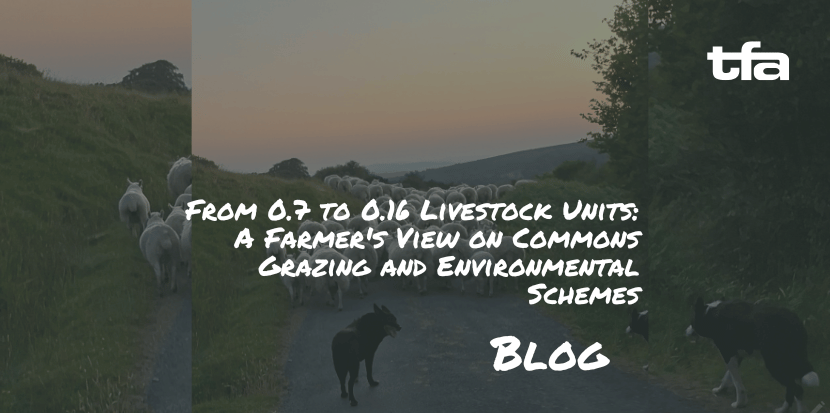
This is a personal blog, written by TFA National Vice Chair, Helen Radmore, who farms with her husband and family in the uplands of Dartmoor National Park.
Before environmental schemes, we were probably grazing our hill farm at around 0.7 livestock units per hectare. The first Environmentally Sensitive Area agreements began on the commons in the late 1990s and early 2000s. We were paid on a profit-forgone basis to reduce our stock by 50%.
The First Ten Years: Environmentally Sensitive Area Agreements
Over the next ten years, the commons showed improvement. We were paid to manage bracken and carry out some controlled burning within the agreement. However, we were also beginning to notice that Molinia, gorse and bracken were starting to take over. There were quiet concerns about nitrogen deposition and about there not being enough grazing by cattle.
Higher Level Stewardship: Livestock Levels Halved Again
At the end of the first ten years came a new environmental agreement: Higher Level Stewardship. Again, payment was based on profit forgone. By the end of that period, our livestock levels were approximately 0.35 livestock units per hectare, down from the original 0.7.
We now have the dubious luxury of being paid to go from 0.35 livestock units per hectare down to 0.24. Most Higher-Level Stewardship agreements were worth less than the original ESA agreements. And now, after a further ten years or more, we have the new Environmental Land Management schemes.
Environmental Land Management: Zero Value for Past Reductions
Under these new schemes, livestock payments appear to be valued at zero for the 0.24 livestock units per hectare we had already reduced to under the previous agreement. We are then asked to reduce further to 0.16 livestock units per hectare, in order to receive another profit-forgone payment. This is not a good business model.
If this direction continues, I can only assume that when I have no livestock left, and therefore no profit forgone, there will be no commoning community left either.
What About the New Environmental Land Management Schemes?
Imagine I were a landowner with grazing rights on a common, or the owner of the common itself. For simplicity, let us say the common covered 1,000 hectares. If everyone voted for the highest payment option, that could mean just 40 cows grazing the common for six months of the year, looked after by one farmer, while those with common rights collectively received in the region of a quarter of a million pounds a year.
If a tenant farmer received any reward, it would likely be taken into account by their landlord when assessing the rent. Is this morally right? Should landowners collect the largest payments while so little food is produced?
Biodiversity or Fuel Load? The Bigger Question
The bigger question is whether this approach will truly deliver biodiversity, or whether it will create a massive fuel load because of climate change, nitrogen deposition and insufficient grazing. Who will put the wildfire out? And who will fill the supermarket shelves?
I can only assume that a rewilder is advising DEFRA.
A Caveat: Supply, Demand and the Next Generation
There is, of course, a caveat. How many farmers will take this option? How many hectares are not currently under agreement? Supply and demand can be a good business model, especially if you are a tenant farmer, or part of the next generation trying to build a business and support your family.
But perhaps you also believe, as I do, that removing too much livestock from our commons is not a resilient move for nature, for farming communities, or for the country.
Related articles:
#365 – How can MPs Help as they contemplate policy for the uplands?
TFA Blog #362 – TFA Responds to DEFRA’s Dartmoor Pony Announcement: “An Urgent Rethink is Necessary”
TFA News article – DEFRA Looks Long-term for Farming and Land Use in England (April March 2026)
Fursdon Review – Independent review of protected site management on Dartmoor
Watch On Demand – TFA Webinar: The Dartmoor Review: Conclusions and Impact for Other Protected Sites
Further Resources from the TFA:
TFA members can get expert one-to-one advice and guidance, by calling TFA head office on 0118 930 6130.
- Find out about TFA membership benefits and rewards
- Browse our Blog archive for the latest news, including farming policy updates
- Explore upcoming TFA events, including webinars, shows and regional meetings